

Will I See Any Birds in Costa Rica?
Yes! You will see lots of birds. The fact is that Costa Rica is home to approximately 930 bird species, making it one of the most diverse birding locations in the world. This includes both resident and migratory species, as Costa Rica’s varied ecosystems, like rainforests, cloud forests, and coastal regions, offer habitats for a broad range of birds. The country’s position along migratory routes also contributes to the high number, with many North and South American birds stopping over during their seasonal migrations.
Just going outside will have you seeing all kinds of birds, it’s very common to see macaws in the central pacific area. They fly to their feeding grounds in the morning and back to where they rest in the evening.

Parrots and parakeets are a captivating sight, with their vibrant plumage, social behavior, and vocal personalities. These birds belong to the Psittacidae family, which includes various species ranging from large macaws to smaller parakeets. Here’s a closer look at these colorful birds and where you can find them in Costa Rica.
Scarlet Macaw (Ara macao)
Appearance: Scarlet Macaws are one of the most recognizable birds in Costa Rica. They have bright red plumage, with blue and yellow feathers on their wings and tail. This dramatic combination makes them one of the most colorful birds in the country.
Size: They are large birds, reaching up to 33 inches (85 cm) in length, including their long, pointed tail feathers.
Habitat: Scarlet Macaws are primarily found in lowland tropical forests and coastal mangroves. They’re most common on the Pacific coast, especially in Carara National Park and the Osa Peninsula.
Behavior: Scarlet Macaws are highly social birds, often seen flying in pairs or flocks. They are known for their loud, squawking calls, which help them communicate over long distances. These macaws are loyal mates, often staying with the same partner for life.
Diet: They primarily eat fruits, nuts, seeds, and berries. Their strong beaks are perfect for cracking open hard nuts, such as those of the beach almond tree, which is a staple in their diet.
Best Times to Spot Them: Early morning or late afternoon is the best time to see Scarlet Macaws as they gather and move between feeding and roosting areas.
Red-lored Parrot (Amazona autumnalis)
Appearance: This medium-sized parrot has mostly green plumage, with a distinctive red patch on its forehead and hints of blue on the wings and tail. The Red-lored Parrot’s colorful accents are less vibrant than those of the Scarlet Macaw but still striking.
Size: About 13 inches (33 cm) in length.
Habitat: Red-lored Parrots are adaptable birds found in lowland rainforests, semi-deciduous forests, and secondary growth areas across the country, especially on the Caribbean side and in the northern regions.
Behavior: These parrots are usually found in small flocks, though they can sometimes gather in larger groups. They’re known for their sharp, repetitive calls and playful behavior.
Diet: Red-lored Parrots feed on a variety of fruits, seeds, nuts, and flowers, often foraging in the forest canopy.
Best Times to Spot Them: Early morning is ideal for spotting these parrots as they feed and call out to each other in the trees.
Orange-chinned Parakeet (Brotogeris jugularis)
Appearance: Orange-chinned Parakeets are small, green parakeets with a subtle orange patch under the chin (which can be hard to see) and bright green wings. They’re less flashy than other parrots but very charming and vocal.
Size: Small, reaching only about 7 inches (18 cm) in length.
Habitat: These parakeets are widespread and adaptable, found in lowland forests, plantations, and even urban areas. They’re particularly common in the Central Valley and lowland areas on both coasts.
Behavior: Orange-chinned Parakeets are highly social and are usually found in flocks. They’re energetic and constantly chattering as they fly from tree to tree.
Diet: They primarily eat seeds, fruits, and flowers, often visiting flowering trees and shrubs.
Best Times to Spot Them: Throughout the day, as they are often seen flitting around in groups and calling loudly.
Where to Spot Parrots and Parakeets
- Carara National Park: On the Pacific coast, this park is a prime spot for Scarlet Macaws, especially in the mangroves and coastal areas.
- Osa Peninsula: Known for its rich biodiversity, this region is home to large flocks of Scarlet Macaws and various other parrots.
- Guanacaste Province: In the northwest dry forests, you can find Yellow-naped Amazons, especially in Santa Rosa National Park.
- Central Valley: For Orange-chinned Parakeets and other smaller parrot species, the Central Valley, including the outskirts of San José, is a good spot.
Fun Facts
Long Lifespans: Parrots are known for their long lifespans, with Scarlet Macaws sometimes living up to 60 years in the wild.
Nest Cavities: Many of these birds are cavity nesters, using hollowed-out trees as their nests. Competition for these nesting sites can be intense.
Mimicking Ability: Some parrots, like the Yellow-naped Amazon, are capable of mimicking sounds, including human speech, and are considered among the most intelligent bird species.
Whether in protected national parks or the forests near your property, you’ll have plenty of opportunities to spot these colorful and intelligent birds in Costa Rica!
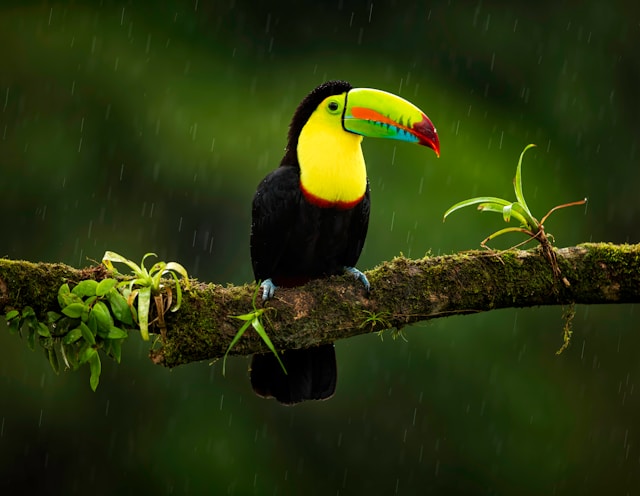
Toucans and toucanets are some of the most beloved and iconic birds, especially for their colorful, oversized beaks and vibrant plumage. Here’s a closer look at these fascinating birds and where you’re most likely to encounter them in the country.
Keel-billed Toucan (Ramphastos sulfuratus)
Appearance: The Keel-billed Toucan is known for its stunning, multicolored beak, often called the “rainbow-billed” toucan. The beak features a blend of yellow, orange, red, and green, making it an unmistakable sight. Its body is mostly black, with a bright yellow throat and chest.
Size: They measure around 17 to 22 inches (43 to 55 cm) in length.
Habitat: These toucans are most often found in lowland rainforests and tropical forests along the Caribbean slope and, to a lesser extent, the Pacific slope.
Behavior: Keel-billed Toucans are social birds that often travel in small groups, foraging for fruits, insects, small reptiles, and even bird eggs. They use their large, lightweight beak to reach fruits on branches that would be otherwise inaccessible.
Best Time for Sightings: They’re most active early in the morning and late in the afternoon, calling out with their distinctive croaking sounds, which resemble a frog’s croak.
Chestnut-mandibled Toucan (Ramphastos ambiguus) / Black-mandibled Toucan
Appearance: Slightly larger and stockier than the Keel-billed Toucan, the Chestnut-mandibled Toucan is mainly black with a yellow chest, a white band separating the chest from the black lower body, and a brownish-red area beneath the tail. Its beak is less colorful, with a yellow upper mandible and a chestnut-brown lower mandible.
Size: This species is the largest toucan in Costa Rica, measuring up to 22 inches (about 56 cm) in length.
Habitat: The Chestnut-mandibled Toucan is primarily found on the Pacific slope in rainforests and tropical lowlands, as well as in areas of secondary growth and forest edges.
Behavior: Like the Keel-billed Toucan, it feeds on fruits, as well as insects, small animals, and other birds’ eggs. They are also known for their loud, yelping calls, often described as “yip-yip” or “dios te dé.”
Best Time for Sightings: They are generally active throughout the day, but you’ll have a higher chance of hearing their calls and seeing them in the early morning.
Where to Spot Toucans and Toucanets in Costa Rica
- Tortuguero National Park on the Caribbean side is a great spot for the Keel-billed Toucan.
- Corcovado National Park on the Osa Peninsula and Carara National Park are popular spots for seeing the Chestnut-mandibled Toucan.
- Monteverde Cloud Forest Reserve and Arenal Volcano National Park also offer opportunities for toucan sightings, particularly of the Keel-billed variety.
Fun Facts
Social Behavior: Toucans are highly social and often sleep together in small groups within tree cavities.
Thermoregulation: Their large bills aren’t just for show; toucans can control the flow of blood to their beaks to help regulate body temperature in the warm tropical environment.
Seeing toucans in the wild is a highlight for any visitor to Costa Rica, and you’re sure to hear their calls echoing through the rainforest if you’re in the right area!

Hummingbirds are some of Costa Rica’s most mesmerizing birds, known for their iridescent colors, rapid wingbeats, and incredible agility. With nearly 50 species in the country, Costa Rica offers a diverse array of these tiny, energetic birds in many different habitats. Here’s an overview of some of the most iconic species and where you’re likely to find them.
Violet-crowned Hummingbird (Amazilia violiceps)
Appearance: The Violet-crowned Hummingbird is notable for its striking violet cap, contrasting with its green body and white underparts. This bold coloring makes it relatively easy to identify.
Size: Medium-sized for a hummingbird, reaching about 4 inches (10 cm) in length.
Habitat: Found primarily in gardens, open woodlands, and along forest edges, especially in lowland areas and mid-elevation zones on both coasts.
Behavior: Known for its territorial nature, this hummingbird often defends flower patches, chasing off other hummingbirds and insects.
Best Places to Spot Them: Common in gardens and forest edges in the Central Valley and lower elevations on the Pacific slope.
Green-breasted Mango (Anthracothorax prevostii)
Appearance: The Green-breasted Mango has a dark green chest and throat, with a metallic green back and a slight blue or purple sheen on its underparts. Females have a distinctive dark line down the center of the chest.
Size: Fairly large, around 4 to 4.5 inches (10 to 11 cm).
Habitat: Prefers lowland rainforests, coastal areas, and gardens, particularly on the Caribbean coast and some parts of the Pacific slope.
Behavior: The Green-breasted Mango is highly adaptable and often visits feeders, making it easy to observe in gardens or lodges with flowering plants or feeders.
Best Places to Spot Them: Common in lowland areas, especially around Tortuguero on the Caribbean coast and Corcovado National Park on the Osa Peninsula.
Fiery-throated Hummingbird (Panterpe insignis)
Appearance: This hummingbird is known for its vibrant, iridescent throat, which shifts between fiery orange, red, and gold in the sunlight. Its body is mostly green with a mix of blue and violet on the head and tail.
Size: Small to medium, measuring around 3.5 inches (9 cm).
Habitat: The Fiery-throated Hummingbird is primarily found in high-altitude cloud forests, especially in the central mountains, where it thrives in cooler temperatures.
Behavior: This species is particularly active, often flying between flowers and bushes at high speeds. It’s one of the few hummingbirds capable of withstanding the colder temperatures of cloud forests.
Best Places to Spot Them: Look for them in Monteverde Cloud Forest, Los Quetzales National Park, and the Savegre Valley.
Hummingbird Habitats in Costa Rica
- Cloud Forests: These high-elevation forests, such as Monteverde and Bajos del Toro, are ideal for spotting species like the Fiery-throated Hummingbird and Purple-throated Mountain-gem. The cooler temperatures and abundance of flowering plants create a perfect environment for these specialized birds.
- Lowland Rainforests: Hummingbirds like the Green-breasted Mango and Violet-crowned Hummingbird thrive in the humid, warm conditions of lowland rainforests on both coasts, including areas like Tortuguero and Manuel Antonio.
- Gardens and Urban Areas: Many hummingbirds, such as the Rufous-tailed Hummingbird, are highly adaptable and can be spotted in urban gardens, especially those with flowering plants or feeders. Hummingbird feeders filled with a sugar-water solution are popular in many lodges and hotels, making it easy for visitors to enjoy these birds up close.
Fun Facts
Wingbeat Speed: Hummingbirds can beat their wings up to 80 times per second, allowing them to hover and make precise movements.
Color Change: The iridescent colors on hummingbirds’ throats and feathers are not due to pigments but are caused by microscopic structures that reflect light, creating the vibrant hues we see.
Long Migration: Some hummingbirds, like the Ruby-throated Hummingbird (which passes through Costa Rica on migration), travel thousands of miles annually between North and South America.
With their iridescent colors and unique adaptations, Costa Rica’s hummingbirds are a must-see for bird enthusiasts and casual nature lovers alike.

Costa Rica’s aquatic birds are as diverse as its landscapes, ranging from the coastlines to inland lakes, rivers, and wetlands. The country is home to many water-loving species that thrive in the rich marine and freshwater ecosystems, including marshes, mangroves, estuaries, and coastal habitats. Here’s an overview of some notable aquatic bird species you might encounter in Costa Rica.
Pelicans and Cormorants
Brown Pelican (Pelecanus occidentalis): This is the only pelican species that dives for fish, making it a spectacular sight along Costa Rica’s coastlines. Brown Pelicans are often seen gliding low over the water or roosting along rocky shores.
Neotropic Cormorant (Phalacrocorax brasilianus): A skilled diver, this bird has dark plumage and is commonly seen perched with its wings spread to dry. Cormorants are excellent swimmers, catching fish underwater.
Habitat: Pelicans and cormorants are primarily coastal but are also found near lakes, estuaries, and larger rivers.

Herons and Egrets
Great Blue Heron (Ardea herodias): This large, stately bird is one of the most recognizable herons, with its slate-gray plumage and long, slender neck. It’s found in various wetland habitats, including rivers, lakes, and coastal areas.
Green Heron (Butorides virescens): Smaller and often more secretive, the Green Heron is recognized by its dark greenish back and chestnut-brown chest. It’s known to lurk near riverbanks, often using tools (like sticks) to lure fish within reach.
Snowy Egret (Egretta thula): With its striking white plumage and black beak, the Snowy Egret is often seen foraging in shallow waters. It’s known for its yellow feet, which it uses to stir up small fish.
Habitat: Herons and egrets are commonly found near freshwater marshes, rivers, mangroves, and coastal wetlands.

Ibises and Spoonbills
White Ibis (Eudocimus albus): This bird is recognizable by its white feathers and bright pink face and legs. The White Ibis often feeds in shallow waters, using its long, curved bill to probe for small invertebrates.
Roseate Spoonbill (Platalea ajaja): Known for its beautiful pink plumage, this bird has a unique spoon-shaped bill, which it sweeps from side to side to catch fish and crustaceans. It’s a favorite among bird watchers for its striking color.
Habitat: Ibises and spoonbills are typically found in swamps, mangroves, estuaries, and salt flats, especially on the Pacific coast.
You can see many of the birds on the crocodile tour through the mangroves! Contact us to book a tour.


